

Avoid Costly Rework on FPL Net Metering: Get Preapproval First

Yes, FPL offers net metering for qualifying solar systems. Your panels power your home first, and any extra electricity flows back through your meter as kWh credits that roll over month to month. Whatever credit balance you haven’t used by the annual true-up in December gets paid out at FPL’s avoided-cost rate under the COG-1 tariff. Before anything else, though, you need to start your net metering application and get pre-approval. Installing panels first is the single most expensive mistake we see.
TL;DR:
Your system’s AC capacity must be 10 kW or less to avoid potential service upgrades and additional costs, with accurate sizing crucial from the start.
FPL’s net metering credits accumulate monthly and are only paid out at the avoided-cost rate during the December true-up, with leftover credits never rolling over beyond one year.
Applications must be submitted and pre-approved before purchasing equipment or installing panels; starting installation prematurely leads to costly delays and rework.
Equipment must meet UL 1741 and IEEE 1547 standards, and interconnection rules prohibit operating the system before receiving Permission to Operate from FPL.
Professional installers help streamline approval, ensure compliance, and coordinate permits, avoiding common pitfalls homeowners face when managing the process alone.
Table of Contents
How Does FPL Net Metering Actually Work?
Net metering sounds complicated until you see it in action. Your solar panels feed your house directly during the day, so the power your refrigerator, air conditioner, and everything else pulls comes from your roof before it comes from the grid. Only what you don’t use gets exported.
That exported electricity is what creates your kWh credits, and here’s how they behave on your bill:
Credits accumulate monthly and show up as a “kWh reserve” on your FPL statement.
You draw down that reserve during months when your system produces less than you consume, like cloudy stretches or peak summer AC usage.
Every December, FPL runs an annual true-up: any kWh you still have banked gets converted to a cash credit at FPL’s average annual avoided-cost rate, known as the COG-1 tariff, rather than carrying forward forever.
Florida Administrative Code Rule 25-6.065 is what forces investor-owned utilities like FPL to offer this in the first place, and it’s also what sets the 12-month rollover window and the avoided-cost payout rule at year-end.
What Size Solar System Qualifies for FPL Net Metering?
FPL sorts systems into three tiers based on AC capacity, and the tier your project falls into determines how much paperwork, insurance, and cost you’re looking at.
Tier 1: systems rated at 10 kW AC or less, which covers most single-family homes.
Tier 2: systems above 10 kW up to 100 kW AC, common for larger homes or small commercial buildings.
Tier 3: systems above 100 kW up to 2,000 kW AC, reserved for larger commercial installs.
One detail trips up a lot of homeowners: your system’s AC rating isn’t the same as the DC nameplate number printed on your panels. FPL calculates AC rating as DC capacity multiplied by 0.85, so a 12 kW DC array typically lands around 10.2 kW AC. If your design pushes past that ceiling, FPL may require a service upgrade, and that cost lands on you. Getting the sizing right from the start avoids a redesign later.
How Do You Apply for FPL Net Metering?
Here’s the sequence that keeps your project moving instead of stalling at inspection:
Start your application and request pre-approval before you order equipment or schedule installation. FPL’s net metering process requires this step first, no exceptions.
Upload your documentation, including your local building permit, equipment specification sheets, and a one-line electrical diagram. Contractors can enter most of the technical details directly through the FPL Net Metering Portal, which speeds up review on FPL’s end.
Pay any applicable fees and submit proof of liability insurance if you’re in Tier 2 or Tier 3.
Wait for FPL’s review and approval. Once approved, FPL schedules installation of your bi-directional meter.
Receive Permission to Operate. Only after this notification can your system legally export power to the grid.
Pro Tip: Never let your installer flip the switch before that Permission to Operate notice arrives. Operating early is a rule violation, and it can also cause billing errors that take months to untangle.
What Does FPL Net Metering Cost, and How Long Does It Take?
Your total cost and timeline depend heavily on which tier your system falls into and how clean your paperwork is.
Tier 1 systems generally face fewer fees than Tier 2 or Tier 3, which require application fees and proof of liability insurance.
If your system’s output approaches your home’s distribution service capacity, FPL may require a transformer or service upgrade, and that expense is billed to you, not absorbed by the utility.
Review timelines shift depending on how quickly your local building department (the AHJ) handles permits and inspections, since FPL won’t schedule your bi-directional meter installation until those boxes are checked.
The most common delays we see: installing panels before pre-approval clears, using equipment that isn’t on FPL’s approved list, and skipping or delaying the required AHJ inspection.
Budgeting for these variables upfront, especially on larger systems, saves you from a surprise invoice midway through the project.
What Technical Rules Must Your Solar System Meet?
FPL’s interconnection standards exist to keep the grid stable and your household safe, and they’re non-negotiable for any system tied into the utility’s lines.
Your inverter must carry UL 1741 and IEEE 1547 certification, both of which require anti-islanding protection so your system automatically stops feeding power to the grid during an outage.
FPL installs a bi-directional meter to measure power flowing both directions, and some system configurations require a visible, manual load-break disconnect switch that utility crews can access.
Your entire installation must comply with NEC Article 690, the electrical code section governing solar photovoltaic systems.
Operating in parallel with the grid before your bi-directional meter is installed is prohibited, and doing so can cause inaccurate billing that’s a headache to fix retroactively.
Battery storage adds another wrinkle. A battery that continuously interconnects and exports to the grid typically needs a separate Small Generator Interconnection Application and may fall outside standard net metering rules. If you’re weighing battery storage for your Florida home, talk to your installer about how it affects your interconnection paperwork before you finalize your design.
How Florida Solar East Helps You Navigate FPL Net Metering
Getting through FPL’s process without a misstep takes local know-how, and that’s where having an experienced installer in your corner pays off. An experienced solar installer can work across residential and commercial solar, from PV systems to solar pool heating, solar hot water, and EV charging stations, and projects often start with a free, no-obligation estimate.
We help you size your system correctly the first time, so you’re not stuck asking for a costly redesign mid-project.
The installer helps ensure equipment meets FPL’s certification requirements.
They can coordinate the pre-approval application, permitting, and inspection processes to streamline paperwork.
Scheduling with FPL for meter installation and final Permission to Operate is often managed by the installer.
What Installers Wish Every Homeowner Knew
The number one mistake I see is homeowners letting a contractor install panels before FPL grants pre-approval. It feels efficient. It almost never is. If your system doesn’t match what FPL approved, you’re looking at rework, delayed activation, or worse, a compliance dispute.
The second mistake: assuming any inverter or panel layout will pass. Check UL and IEEE listings and your local AHJ’s permit checklist before you sign a contract, not after.
— Ronnie
Get Your FPL Net Metering Project Started the Right Way
If you’re comparing DIY research against hiring help, here’s the honest tradeoff: doing it yourself means you’re the one tracking FPL’s pre-approval portal, chasing permit paperwork, and hoping your equipment matches the tier requirements. Florida Solar East handles that coordination for you, backed by competitive pricing, flexible financing, and eligibility for the 30% federal tax credit on qualifying installations.

A free estimate gets you a real sizing plan tailored to your roof and your FPL account, not a generic quote. Our team manages the pre-approval application, permit submission, and equipment selection so your system meets FPL’s interconnection standards the first time, which keeps your Permission to Operate timeline on track. Whether you’re looking at residential solar or want to add EV charging stations to your project, request your free estimate today and let us handle the FPL coordination while you plan for lower bills.
Where to Verify Current FPL Net Metering Rules
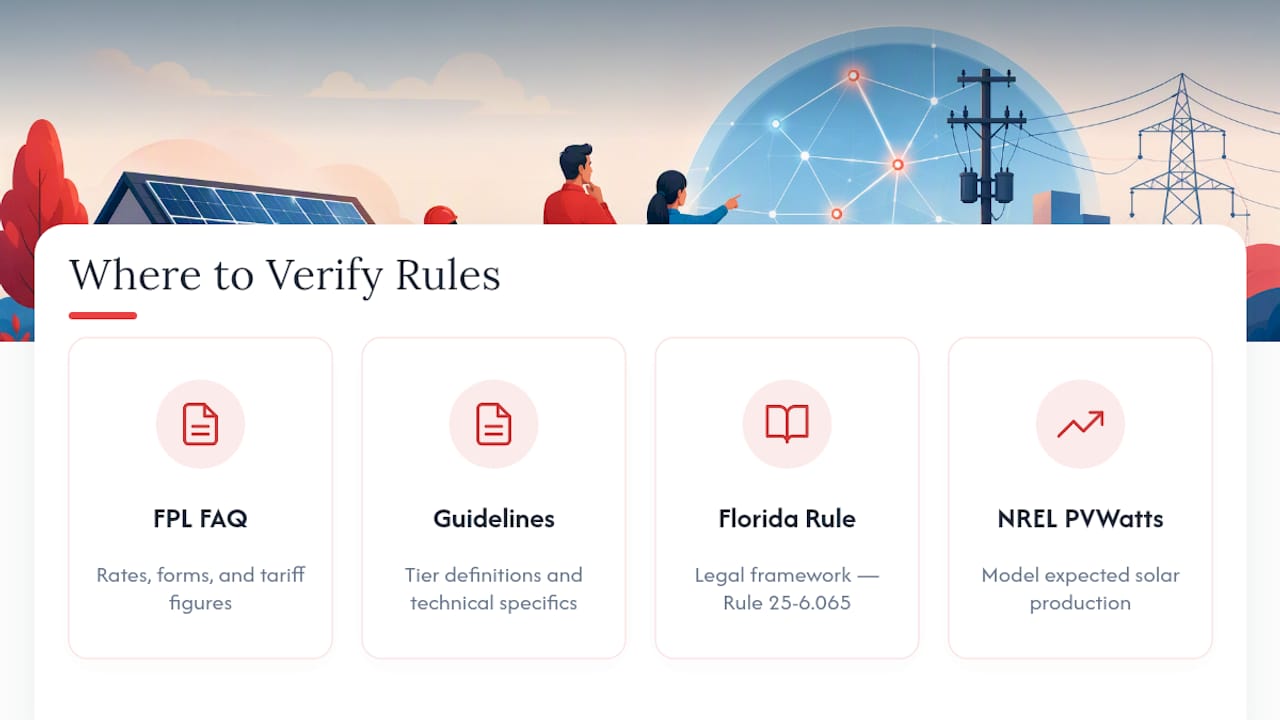
Rates, forms, and tariff figures change, so confirm the details that affect your project directly through official sources. Start with FPL’s net metering FAQ page and the net metering guidelines for tier definitions and technical specifics. Florida Administrative Code Rule 25-6.065 lays out the legal framework behind the program. For production estimates, NREL’s PVWatts tool is a solid resource for modeling expected solar output on your property. Always check your own FPL account for your specific true-up month, since it can affect how you plan your system size. For a deeper dive into how Florida’s net metering rules apply statewide, that’s worth a read too. And if you’re trying to cut your utility bill further, this roundup of utility bill savings strategies covers ground net metering alone doesn’t.
Sources
FAQ
What Are the Current FPL Net Metering Rates?
FPL doesn’t publish a single flat rate. Instead, your exported energy earns kWh credits at retail value throughout the year, and only leftover credits at the December true-up get paid out at FPL’s average annual avoided-cost rate under the COG-1 tariff.
Is Net Metering Worth It in Florida?
For most homeowners, yes, since it lets your solar production offset the bulk of your energy charges throughout the year. Keep in mind that net metering reduces your energy usage charges but doesn’t eliminate fixed monthly customer charges or demand charges, so your bill won’t drop to zero even with a well-sized system.
What Are the Downsides of Net Metering?
The biggest practical downside is the paperwork sequence: you must get FPL pre-approval before installation, and skipping that step can force expensive rework. Larger Tier 2 and Tier 3 systems also carry added costs like insurance requirements and potential service upgrades that Tier 1 homeowners rarely encounter.
How Does Net Metering Work With FPL Specifically?
Your solar system powers your home first, and any surplus electricity exports through your meter to create kWh credits. Those credits roll over monthly until the annual true-up, when unused credits convert to a cash payout instead of carrying forward indefinitely.
Does Florida Solar East Help With the FPL Application?
Yes. Florida Solar East assists with sizing your system, selecting UL-listed equipment, and managing the pre-approval application and permit coordination so your project moves through FPL’s process without avoidable delays. Current estimates and financing details are available through a free consultation.
Recommended

Comments