

Stop Lowball Solar Quotes: Normalize to $/W and Verify With PVWatts
- Ronnie Brewer
- 2 days ago
- 9 min read

The fastest way to compare solar quotes is to normalize every proposal to cost per watt and net cost after incentives, then check the quoted production against NREL PVWatts. Once the numbers match up, pick the installer with the strongest equipment and warranty coverage, not the lowest sticker price. That single move puts every bid on the same footing.
TL;DR:
Verify that every solar quote includes the total cost, system size, production estimate, scope of work, and warranty details before comparing proposals.
Normalize quotes by calculating cost per watt and net cost after incentives, then compare production estimates to PVWatts to identify inflated projections.
Beware of quotes with production estimates over 15% above PVWatts or those bundling battery costs, as these can mislead about true value.
Ask detailed questions about equipment specifications, warranty coverage, and included work to identify vague or potentially deceptive quotes.
Budget for additional costs like roof repairs, electrical upgrades, trenching, and permits, which are often not included in the initial proposal.
Table of Contents
What Numbers Should You Pull From Every Solar Quote?
Every proposal you receive should hand you the same set of numbers. If it doesn’t, ask for them before you do anything else.
Start with the total installed cash price before any incentives, plus the financed total if you’re borrowing. Then grab the DC system size in kW, because that’s what lets you calculate dollars per watt, the single most useful number for comparing solar proposals. Residential solar in the U.S. typically costs around the national average per watt before incentives, with a competitive range reflecting common market prices, so anything wildly outside that band deserves a second look.
Here’s your extraction checklist for each quote:
Total cost: cash price and financed price, listed separately
System size (kW): used to calculate cost per watt
Annual production estimate (kWh): plus the tilt, azimuth, and derate assumptions behind it
Itemized scope: roof repairs, electrical panel upgrades, trenching, permitting fees, and battery pricing as a standalone line
Warranty terms: product warranty, performance warranty, workmanship warranty, and who actually stands behind each one
Installers must spell out exactly what roof, electrical, and permitting work is included, because exclusions here are where surprise invoices come from later. If a quote is vague on any of these five items, that’s your first sign to push back before signing anything.
How Do You Turn Multiple Quotes Into One Comparison?
Two quotes with different system sizes, different incentive assumptions, and different production numbers look impossible to compare side by side. They aren’t, once you run them through the same three calculations.
Calculate cost per watt. Divide total cost by system size in watts. A $27,000 quote for a 10 kW system comes to $2.70/W. A $24,000 quote for an 8 kW system comes to $3.00/W, which looks cheaper on paper but delivers less power.
Strip out battery and non-solar costs first. If a battery isn’t itemized separately, you can’t calculate an honest solar $/W, because bundled storage costs distort the comparison every time.
Calculate net cost. Subtract every verified incentive from total cost. This is the number that actually determines your payback period, not the sticker price.
Verify production against PVWatts. Run your address through NREL’s free tool and compare it to the installer’s estimate.
Calculate simple payback. Divide net cost by your estimated annual savings to get a rough number of years to break even.
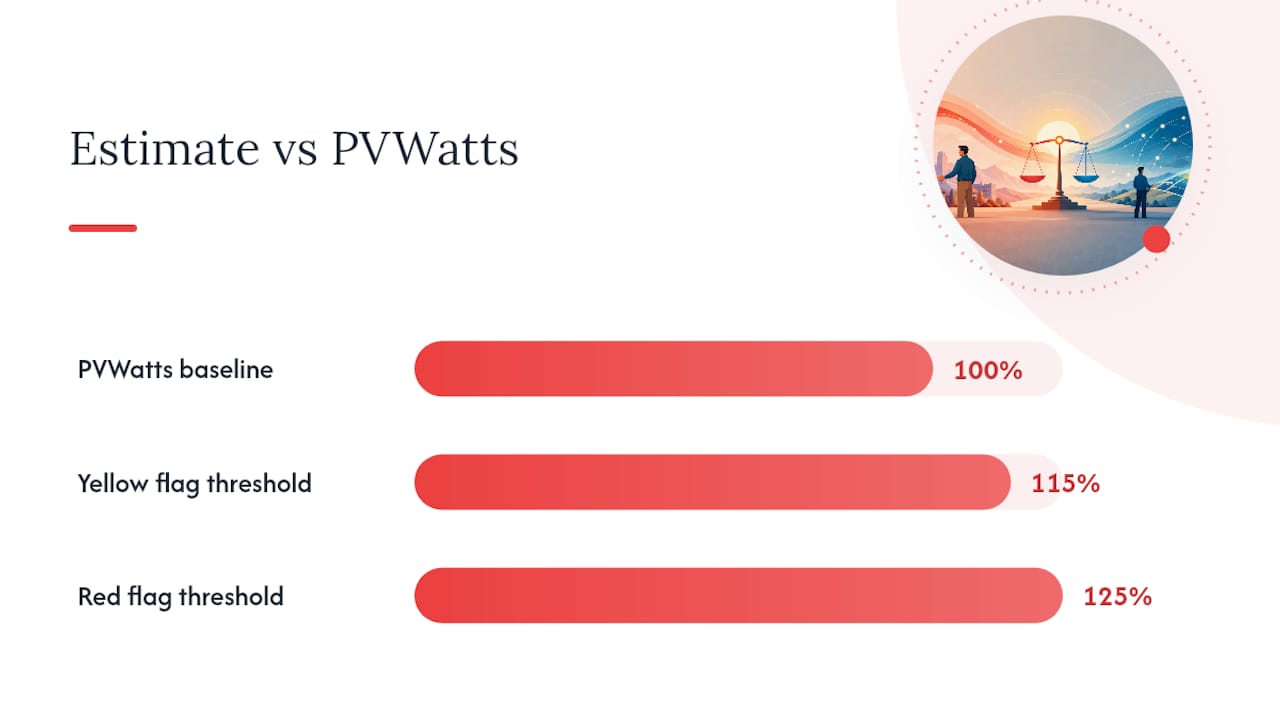
Statistic to watch: if an installer’s production estimate comes in more than 15% above the PVWatts figure for your address, treat it as a yellow flag. More than 25% above PVWatts is a red flag, and it usually means the assumptions behind your projected savings are inflated.
A quote that looks $3,000 cheaper but assumes production 20% higher than PVWatts isn’t actually the better deal. It’s a worse one wearing a lower price tag.
What Questions Expose a Bad Solar Quote?
Some red flags show up in the numbers. Others show up in how an installer answers a direct question.
Watch for these warning signs first:
A cost per watt that’s dramatically below $2.50/W with no clear explanation
Refusal to itemize battery costs separately from the solar system
Production estimates that exceed PVWatts by more than 15%
No written workmanship warranty, or a vague verbal promise instead
Pressure to sign same-day with a “special pricing” deadline
Send these seven questions to every installer bidding on your project:
What panel model and inverter type are you quoting, and can you send the spec sheets?
What assumptions (tilt, azimuth, shading losses) generated your production estimate?
Can you itemize the battery cost separately from the solar system cost?
What exactly does your quote include for roof work, electrical upgrades, and permitting?
Who issues the workmanship warranty, and for how many years?
Is your production estimate consistent with NREL PVWatts for my address?
Can you confirm your installer credentials through NABCEP?
Pro Tip: A slow, detailed answer to these questions is a good sign. A fast, vague answer usually means the installer hasn’t done the homework, or doesn’t want you to see it.
What Equipment and Warranty Details Actually Matter?
The panel brand printed on a glossy brochure tells you almost nothing on its own. What matters is rated wattage, efficiency percentage, expected annual degradation, and whether the manufacturer has staying power. Panel reliability research from NREL shows degradation rates and manufacturer track record directly affect whether a 25-year warranty is worth much in year 15.
Inverters come in three flavors, and the choice affects both output and maintenance:
String inverters are the cheapest option and work well on simple, unshaded roofs
Microinverters attach to each panel individually, which improves performance on complex or partially shaded roofs
Power optimizers sit between string and micro, boosting output without full per-panel hardware
Warranties aren’t one thing. A product warranty covers manufacturing defects, a performance warranty guarantees a minimum output over time, and a workmanship warranty covers the installer’s own work, like leaks or mounting failures. Confirm who issues each one, because a manufacturer warranty is only as good as that manufacturer’s longevity, and an installer workmanship warranty is only as good as that company still being in business. Ask directly what happens to your warranty if you sell the house or replace your roof. For deeper detail on what solar panel warranties actually cover, it’s worth reading the fine print before you sign.
How Do Financing and Incentives Change the Real Price?
Every quote should show you two numbers: the cash price and the financed price. Comparing only monthly payments hides the total cost, and a lower payment stretched over a longer term can cost more overall.
Here’s how to treat incentives and financing when you’re lining up quotes:
Apply the federal solar tax credit to your net cost, and confirm your specific eligibility through IRS guidance rather than assuming a flat percentage applies to your situation
Request both cash and financed pricing from each installer, then compare APR and total repayment, not just the monthly number
Verify any state or utility rebate directly through the program’s own documentation instead of trusting an installer’s verbal estimate
Recalculate net cost and payback using only confirmed incentives, never projected ones that haven’t been approved yet
A quote advertising “$0 down, low monthly payment” can still cost thousands more over 20 years than a straightforward cash purchase. Run the total repayment number before you decide anything.
What Happens Between Signing and Flipping the Switch?
Once you accept a quote, the clock starts on a process that typically runs eight to twelve weeks in most markets, though permitting backlogs can stretch that timeline.
The first two to three weeks usually cover the site survey and engineering design, where the installer confirms roof condition, electrical panel capacity, and finalizes the exact equipment layout. Next comes permitting, which often takes the longest stretch, anywhere from two to six weeks depending on your local building department. Some jurisdictions move fast; others sit on applications for a month or more, so ask your installer for a realistic permitting estimate specific to your city or county.

Once permits clear, installation itself is fast, usually one to three days for a typical residential system. What takes longer is what comes after: the utility interconnection approval, where your utility company inspects and approves the system to connect to the grid. This step alone can take another two to four weeks.
Only after interconnection approval does your system get permission to operate (PTO) and switch on. Ask every installer for a written timeline estimate broken into these four phases, because a quote that’s silent on timeline is a quote that hasn’t planned for permitting delays.
What Hidden Fees Should You Budget For?
The number on the front page of a solar quote is rarely the number you’ll actually pay. Additional costs tend to surface in a handful of predictable places.
Roof condition is the most common surprise. If your roof needs repair or replacement before panels go up, that cost typically isn’t in the original solar quote unless you specifically asked for it to be itemized. Electrical panel upgrades are another frequent add-on. Older homes with a 100-amp panel often need an upgrade to 200 amps to handle a solar system safely, and that can add real cost if it wasn’t scoped from the start.
Trenching and conduit work matters if your electrical panel isn’t near your desired panel or inverter location. Permitting and inspection fees vary by municipality and aren’t always included in the headline price. Battery add-ons, if you’re considering storage, should always appear as a separate itemized cost rather than folded into the solar number, since bundling storage without breaking it out makes true cost-per-watt comparison impossible.
Ask each installer point blank: “What is not included in this price?” A thorough installer will have a ready answer. One who hesitates or gives a vague response is telling you something about how the rest of the project will go.
How Florida Solar East Reviews a Quote Before You Sign
We run every proposal through the same checks outlined here: cost per watt, verified production, itemized scope, and warranty terms in writing. The most common issue we see in the field is a competing quote that bundles battery pricing into the solar number, making it look cheaper than it actually is once you separate the two.
Our team walks you through equipment options, financing choices including the federal tax credit, and a full residential solar proposal with nothing hidden in the fine print. If you already have a quote in hand and want a second set of eyes, reach out through our home page and we’ll run the numbers with you, free of charge.
Get a Free, Itemized Solar Estimate From Florida Solar East
Myfloridasolar gives you the exact numbers this guide tells you to demand, upfront, instead of making you extract them line by line from a confusing PDF.

Before you request your estimate, have your most recent electric bill on hand, a few photos of your roof if possible, and a sense of whether you want to pay cash or explore financing. That’s enough for our team to build a real, itemized proposal instead of a rough guess. Whether you’re comparing us against another bid or starting fresh, you’ll get a quote built the same transparent way every time. Request your free solar quote and see exactly what a properly itemized proposal looks like.
How Financially Sound Is Your Perspective on Solar Quotes?
Most homeowners assume the biggest risk in going solar is picking a bad company. It’s actually simpler and more common than that: comparing quotes that were never built to be compared in the first place. One installer quotes a 9kW system, another quotes 11kW, one bundles a battery and one doesn’t, and the homeowner is left staring at three numbers that don’t mean anything next to each other.
What gets underestimated is how much a lowball $/W figure can mask. A price that looks 20% cheaper often comes with a thinner workmanship warranty, an unnamed inverter brand, or a production estimate that’s been quietly inflated to make the payback math look better than reality. Energy.gov’s own guidance backs this up: the cheapest quote frequently conceals compromises in equipment or coverage that only show up years later, when a panel underperforms or a workmanship claim gets denied.
The fix isn’t complicated, but it does require doing the math yourself instead of trusting a sales rep’s summary slide. Normalize to $/W, check the number against PVWatts, and read the warranty section like it matters, because it does.
— Ronnie
Where to Verify Solar Numbers Independently
Check your address against NREL PVWatts for an unbiased production estimate. Energy.gov’s homeowner guidance covers incentives and upgrade planning. A solar comparison calculator can help organize multiple quotes side by side.
Sources
Recommended

Comments