

Why Florida Solar Incentives Still Save Homeowners in 2026
- Ronnie Brewer
- 2 hours ago
- 9 min read

Two statewide tax breaks remain permanent and unaffected by federal changes: Florida’s 100% sales-tax exemption and 100% property-tax exclusion for solar equipment. Most investor-owned utilities still credit exported solar power at full retail value.
TL;DR:
Florida’s sales-tax exemption covers 6% on solar equipment, saving approximately $1,680 on a typical $28,000 system, but excludes labor costs.
The property tax exclusion prevents assessed value increases from adding to your tax bill if solar equipment enhances your home’s value, which can be significant for high-value systems.
Full retail net metering remains in place for investor-owned utilities, so sizing your system near your annual usage maximizes the value of exported power.
Local rebates and utility incentives are limited, often first-come, and require careful documentation and certification to qualify.
The federal residential solar tax credit expires after December 31, 2025, but Florida’s state exemptions offer long-term savings independent of federal policy changes.
Table of Contents
Florida Solar Incentives That Still Cut Your Costs
You’re not imagining it if the incentive landscape feels different than it did a couple of years ago. The federal 30% credit that homeowners leaned on for over a decade is gone for new residential purchases. But Florida’s own tax breaks never depended on Washington, and they’re doing more heavy lifting now than most homeowners realize.
Two state statutes create the backbone of Florida’s solar savings. Fla. Stat. 212.08(7)(hh) exempts qualifying solar equipment from the state’s 6% sales and use tax. That covers panels, inverters, racking, and in most cases battery storage paired with a solar system. Installation labor is typically taxed separately, so ask your installer for an itemized quote that shows the equipment cost and tax savings clearly.
The second piece, Fla. Stat. 193.624, excludes 100% of the added home value that solar equipment creates from your property tax assessment. Install a $25,000 system that boosts your home’s value by that same amount, and your county appraiser is required to exclude it from the taxable assessment. That protection applies to residential renewable energy devices statewide, though homeowners still need to confirm the exemption gets applied.
Here’s the number that matters: on a typical $28,000 residential system, the sales-tax exemption alone saves roughly $1,680 upfront, since qualifying equipment would otherwise be taxed at 6%.
A few practical notes:
Some counties process the property-tax exclusion automatically once permits are recorded, while others require the homeowner to file documentation.
Local discretionary surtaxes on top of the state sales tax do not apply to exempt solar equipment either.
Keep every receipt and equipment spec sheet. If your appraiser’s office ever questions an assessment increase, that paperwork is your proof.
How Net Metering Determines What Your Exported Power Is Worth
Net metering is arguably the most valuable ongoing incentive Florida homeowners have, and it works because state rule requires it. When your solar system produces more electricity than your home uses, that excess flows back to the grid and your utility credits your account at the full retail rate, not a discounted wholesale rate. Credits generally roll forward month to month, and any credits still unused at your annual true-up are paid out at the utility’s avoided-cost rate, which is considerably lower than retail.
Florida’s investor-owned utilities are required to offer retail net metering to qualifying customers. That group includes:
Florida Power & Light (FPL)
Duke Energy Florida
Tampa Electric (TECO)
Gulf Power
Municipal utilities and electric cooperatives set their own terms, and they don’t always match the investor-owned standard. Orlando Utilities Commission (OUC), for example, has adjusted its export compensation structure in recent years, so homeowners in OUC territory should verify current terms before assuming full retail credit. The same goes for smaller municipal providers and rural cooperatives.
Pro Tip: Call your utility’s interconnection department before you sign a contract, not after. Ask directly whether you’re on full retail net metering or a modified rate, since that answer changes how large a system makes financial sense.
Net metering terms directly affect system sizing. If you’re getting full retail credit, it usually makes sense to size your system close to your annual usage, since every exported kilowatt-hour is worth the same as one you’d otherwise buy. Under a reduced export rate, oversizing your system loses some of its payoff, and pairing it with a residential battery to store excess power for your own use can be the better move. For a deeper breakdown of how these credits are calculated month to month, Myfloridasolar’s net metering guide walks through the mechanics utility by utility.
Local Rebates and Utility Programs Worth Checking Before You Sign a Contract
State tax exemptions apply everywhere in Florida, but a handful of cities and utilities layer on their own rebates. These programs tend to be smaller, first-come-first-served, and easy to miss if your installer isn’t tracking them closely.
Boynton Beach residential solar rebates. The city has offered rebates for qualifying residential solar installations, generally capped at a modest fixed amount per home and limited by annual budget.
Dunedin’s solar grant program. Dunedin has run grant programs supporting residential solar adoption, typically requiring pre-approval before installation begins.
OUC battery storage rebates. Orlando Utilities Commission has offered incentives for customers who add battery storage, which pairs naturally with its modified net metering terms.
Clay Electric solar water heater rebates. Clay Electric Cooperative has provided rebates for solar water heating systems, often requiring Florida Solar Energy Center (FSEC) or Solar Rating & Certification Corporation (SRCC) certified equipment.
These programs share a few traits. Funding is usually limited and distributed on a first-come basis, so timing your application matters as much as qualifying for it. Certification requirements are common, particularly for solar water heaters and pool heating equipment, and your installer should confirm that quoted equipment meets FSEC or SRCC standards before you commit. Because city councils and utility boards revise or discontinue these programs without much notice, verify current availability directly with the city or utility rather than relying on a rebate list you found online, including this one.
Financing Options: PACE Loans, Solar Loans, and Leases
Not every homeowner wants to pay cash upfront, and Florida has more than one path to spreading out the cost.
Property Assessed Clean Energy (PACE) financing lets you fund a solar installation and repay it through your property tax bill as a non-ad valorem assessment. Florida’s PACE programs are authorized by state statute but administered locally, so terms, interest rates, and consumer protections vary by county or municipality. PACE obligations typically transfer to the next owner if you sell, which can be an advantage or a complication depending on your timeline.
Traditional solar loans work more like a home improvement loan. When comparing offers, look closely at:
The loan term, since a longer term lowers your monthly payment but increases total interest paid.
Whether the rate is fixed or adjustable.
Any dealer fees baked into the loan that inflate the effective interest rate beyond what’s advertised.
Leases and power purchase agreements (PPAs) work differently. A third party owns the system, you pay for the power it produces, and that owner can potentially claim the commercial Section 48E federal credit since it applies to third-party-owned systems rather than homeowner purchases. Some of that savings gets passed to you through a lower monthly rate, though the value varies by provider and contract structure.
Pro Tip: If a lease or PPA salesperson tells you that you’re “still getting the tax credit,” ask them to show exactly how. The credit goes to the system’s owner, and under a lease, that’s not you.
What Losing the Homeowner Tax Credit Actually Costs You
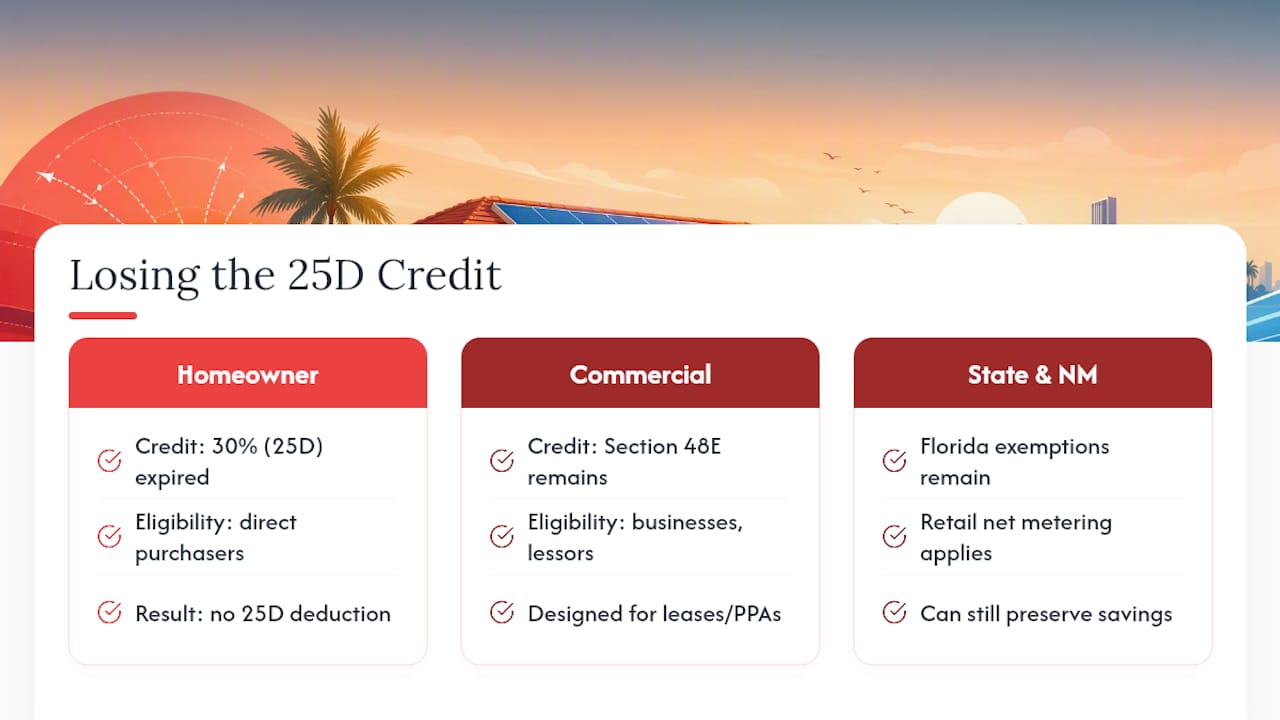
The residential Clean Energy Credit under Section 25D expired for homeowner-purchased systems placed in service after December 31, 2025. For over a decade, this credit let homeowners deduct 30% of their system cost directly from their federal tax bill. That’s gone now for anyone who buys and owns their system outright.
Section 48E, the commercial and third-party credit, still exists with its own eligibility rules and deadlines, but it’s built for businesses and system owners like lease and PPA providers, not homeowners who purchase directly.
Here’s what that shift does to a typical installation:
Florida’s state exemptions don’t close that gap, but they’re the reason the math still works for many homeowners, especially once retail net metering is factored into the annual savings. For more on how this transition affects specific purchase scenarios, Myfloridasolar’s guide to the 2025-2026 credit changes breaks down timing considerations in more detail.
Your Step-by-Step Checklist for Claiming Every Incentive
Getting these incentives isn’t automatic. A little paperwork now prevents a lot of frustration later.
Get equipment documentation from your installer. Request spec sheets for panels, inverters, and batteries, along with proof they meet FSEC or SRCC certification where required for local rebates.
Keep your purchase receipt and itemized invoice. You’ll want a clear breakdown of equipment cost versus labor for both the sales-tax exemption and any future property assessment questions.
Confirm your property-tax exclusion with the county appraiser. Some counties apply the 193.624 exclusion automatically after permit closeout; others want a form filed directly.
Save your final inspection and interconnection approval. These documents prove the system is complete and grid-connected, which utilities require before activating net metering.
Check your specific utility’s net metering policy before signing anything. Terms differ between investor-owned utilities and municipal providers, and permit and interconnection timelines can run several weeks.
Pro Tip: Ask your installer directly: “Who is responsible for filing the property tax exemption paperwork, you or me?” Get the answer in writing before installation starts. For a full walk-through of permit steps and inspection timing, see Myfloridasolar’s permit requirements guide.
Why Incentives Actually Drive Installation Decisions in Florida
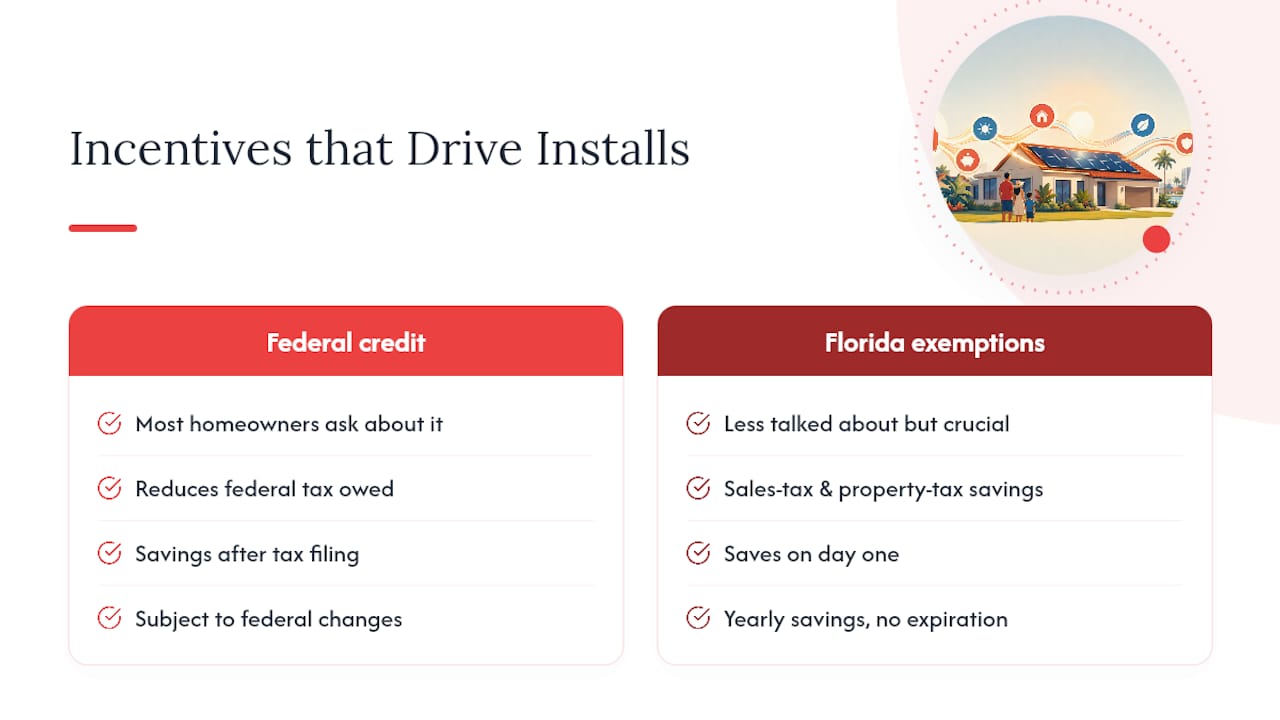
Homeowners tend to ask about the federal credit first because it’s what they’ve heard about for years. In practice, Florida’s own exemptions are what make solar consistently affordable here regardless of what Congress does. A system that qualifies for the sales-tax exemption and the property-tax exclusion saves money on day one and every year after, without any expiration date attached.
Florida Solar East has installed photovoltaic systems, solar pool heating, and solar hot water systems across the state, and paperwork accuracy on the front end is often what determines whether a homeowner actually captures the property-tax exclusion months later. Free site estimates and financing guidance are standard parts of that process, including a clear breakdown of what’s currently eligible for tax exemption and what financing structure fits your situation.
Specific dollar savings vary by home, system size, and utility territory, so treat every figure here as a starting point for your own conversation with a licensed installer, not a guaranteed outcome.
What I’d Tell a Neighbor Asking About Solar Right Now
Most of the confusion homeowners bring to me starts with outdated information about the federal credit. People assume it still applies, and when they find out it doesn’t, some conclude solar no longer makes sense in Florida. That conclusion skips over what actually changed and what didn’t.
What changed is a temporary federal subsidy. What didn’t change are two permanent state exemptions and a utility rule that guarantees you get paid full retail price for power you don’t use yourself. Those three things, not the federal credit, were always the more durable part of the Florida solar equation.
If you’re evaluating solar in 2026, prioritize confirming your utility’s net metering terms before you compare system quotes. That number affects your payback math more than almost anything else, and it varies enough between providers that assuming “standard” terms is a mistake. Get that answer first, then let the state exemptions do the rest of the work.
— Ronnie
Get a Free Estimate and Find Out What You Actually Qualify For
Figuring out which exemptions apply to your specific home, and making sure the paperwork actually gets filed, is where most homeowners lose money without realizing it. Myfloridasolar handles that groundwork directly, so you’re not left guessing whether your county appraiser processed your exclusion or whether your installer’s equipment even qualifies for the sales-tax exemption.

Here’s what that includes:
A free, no-obligation site estimate for residential solar, sized around your actual energy usage and roof
Guidance on financing options, including how the loss of the federal homeowner credit affects your total cost
Support with the documentation your county appraiser and utility require for tax exemptions and net metering approval
Florida Solar East also installs solar pool heating and solar hot water systems, both of which qualify for the same statewide sales-tax exemption covered earlier. If you’re ready to see real numbers for your property, request your free residential solar estimate and get a straight answer on what you qualify for before you commit to anything.
This article is general information, not a substitute for advice from a qualified financial advisor. Consult a qualified financial professional about your own circumstances before acting on anything here.
Sources
Recommended

Comments