

Homeowners: Get Installer Ready Solar for AC and Claim the 30% Credit

Yes, a properly sized grid-tied PV system can substantially cut the electricity cost of running air conditioning, especially when paired with storage or PV-prioritized controls. Cooling demand peaks during daylight hours, right when solar panels produce the most power, and research shows the economics improve even further in hotter climates. Federal tax credits are available that can reduce the upfront investment substantially. The sections ahead cover sizing math, storage choices, HVAC efficiency, real costs, and what to demand from any installer’s proposal.
TL;DR:
The optimal PV system size for air conditioning depends on converting AC load to wattage, sun hours, and including surge capacity for compressors.
Battery backup is worthwhile mainly when export credits are weak or time-of-use rates are high, while thermal storage offers a cheaper alternative for larger cooling loads.
Upgrading to a higher SEER inverter-driven air conditioner can significantly reduce the PV array size needed for effective cooling offset.
Proper installer proposals should include detailed AC load estimates, hourly modeling, surge protection, and clear financial justifications to avoid guesswork.
Combining solar thermal water heating with PV for cooling can improve overall efficiency by prioritizing energy use and reducing electric loads.
Table of Contents
How Solar Powered AC Systems Actually Offset Your Cooling Load
Your air conditioner runs hardest between noon and 6 p.m., which is exactly when a south or west-facing PV array hits peak output. That overlap is the whole reason solar energy cooling works as well as it does. When your panels are producing more power than your AC is pulling, you’re using that solar power directly instead of buying it from the utility. That’s called self-consumption, and it’s the single biggest factor in how much you actually save.
The value of that self-consumed power depends heavily on your utility’s compensation structure. If your utility pays close to retail rate for exported solar, exporting extra midday power isn’t a big loss. If you’re on a time-of-use plan or a net-billing structure that pays less for exports than it charges for imports, using that power directly on your own AC unit becomes far more valuable than sending it to the grid.
Three basic approaches exist for solar air conditioner installation:
Grid-tied, no battery. The simplest and cheapest setup. Panels offset AC use during the day, and you draw from the grid at night. This works well almost everywhere and pays back fastest.
Hybrid with battery backup. Panels charge a battery that covers evening cooling loads or outages. Justified mainly when TOU rates or weak export credits make grid power expensive after sunset.
Off-grid. Rare for residential AC because cooling loads are large and constant; batteries and panel counts both balloon in cost.
For most homeowners, grid-tied without storage delivers the best return per dollar. Batteries earn their keep only under specific rate structures, which we’ll cover shortly.
How Big Should Your Solar Array Be for Air Conditioning?
Sizing a photovoltaic air conditioning system comes down to a chain of unit conversions, not guesswork. Here’s the logic installers use, step by step:
Convert your AC’s tonnage or BTU rating to running watts. A 1-ton unit draws roughly at least a thousand watts; a 3-ton central system runs several thousand watts, depending on the SEER rating.
Multiply by daily run hours and duty cycle. A unit that runs 8 hours a day at a 60% duty cycle (compressor cycling on and off) gives you your daily kilowatt-hour need.
Divide by peak sun hours (PSH) for your location. Florida typically sees 5 to 5.5 PSH; this tells you how many “full-sun equivalent” hours your panels get.
Divide again by panel wattage and apply a derate factor. A standard 0.83 derate accounts for inverter losses, wiring, dust, and heat. Most residential panels today run 400 to 440 watts.
Pro Tip: A rough industry benchmark: expect roughly a few panels to meaningfully offset a small window unit, and about a dozen panels for a 3-ton central AC, depending on your SEER rating, sun hours, and duty cycle assumptions.
That range is wide on purpose. Small changes in duty cycle or PSH shift the panel count meaningfully, which is why rough rules-of-thumb should never replace a real proposal.
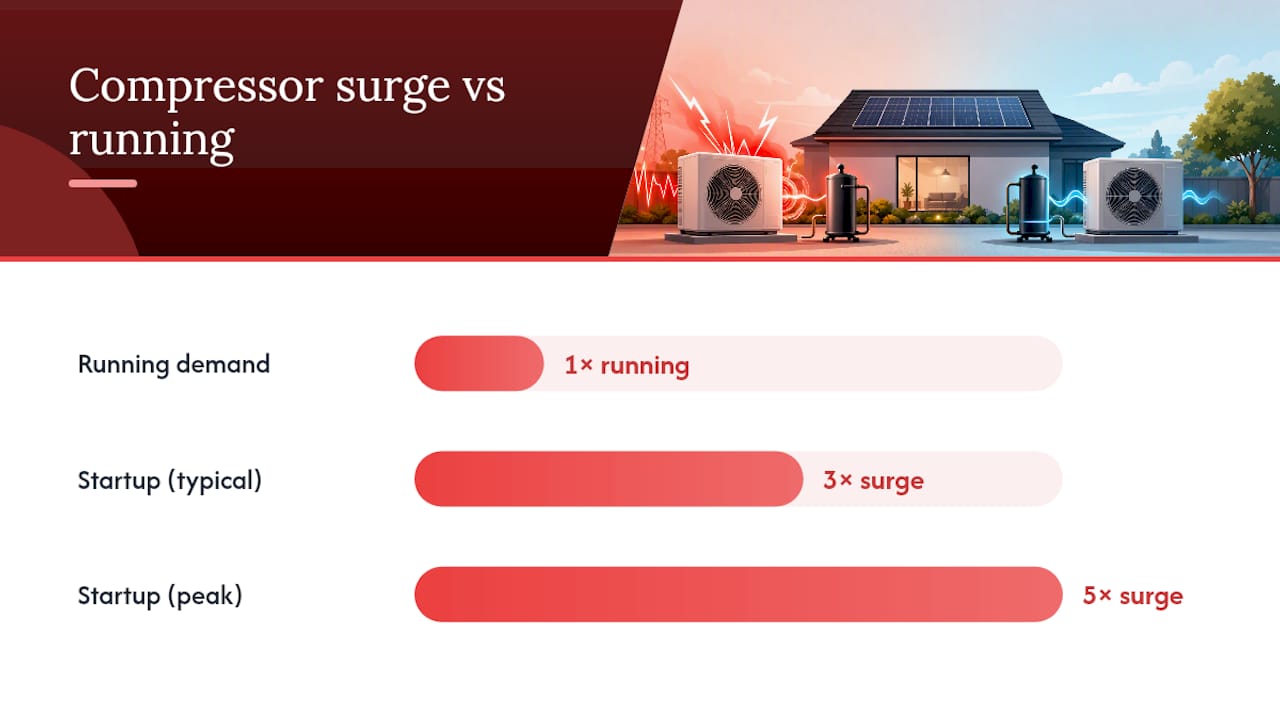
One more wrinkle: compressor startup draws a surge of current far above running watts, sometimes 3 to 5 times higher for a second or two. Off-grid and battery-backed systems need an inverter sized to handle that surge, or a soft-start device on the compressor, or both. Grid-tied systems without batteries rarely need to worry about this since the grid absorbs the surge.
Storage and Control Strategies That Maximize Solar Use for Cooling
Not every AC-heavy home needs a battery. Thermal storage, chemical batteries, and smart controls each solve a different piece of the puzzle, and picking the wrong one wastes money.
Thermal storage (ice or chilled-water buffers) is dramatically cheaper per kilowatt-hour stored than a battery, and works well for larger commercial cooling loads.
Batteries make sense mainly when your utility’s export credit is weak or when you’re on time-of-use pricing that makes evening grid power expensive.
Control strategies, from simple rule-based logic to more advanced approaches like SG Ready, shift loads or divert surplus solar toward cooling and hot water, and studies on PV-plus-heat-pump control strategies show measurable self-consumption gains without the cost of a full battery bank.
Techno-economic modeling on solar-powered cooling systems paired with thermal storage backs this up. It shows that combining PV with thermal buffers can shift a real share of your evening cooling load off the grid, lowering the levelized cost of cooling in hot climates. If you’re weighing storage options for your home, our breakdown of residential solar battery choices walks through the trade-offs in more detail.
Pro Tip: If your export credit is close to your retail rate, skip the battery and put that money toward more panels or a thermal buffer instead. Batteries earn their cost back fastest under punishing TOU rate structures, not flat ones.
Upgrade Your AC First, Then Size the Solar
Before you add a single panel, check your AC’s SEER rating. A jump from an aging SEER 10 unit to a modern SEER 18 or higher inverter-driven system can cut the watts needed per BTU of cooling dramatically, which shrinks your entire solar array requirement.
Higher SEER units draw less power for the same cooling output, directly reducing the panel count needed to offset them.
Inverter-driven mini-splits run at variable speed instead of full-blast on/off cycling, which softens startup surge and makes them easier to pair with solar, especially in battery-backed designs.
If your roof or budget can’t fit the panel count your current AC demands, upgrading the AC itself is often the more cost-effective move than adding more panels.
Reducing your home’s cooling load before you size solar, through better insulation or a solar attic fan, can shrink the required system even further.
Costs, Incentives, and Financing for an AC-Focused Solar Project
Your payback timeline depends on four levers: your retail electricity rate, your utility’s export credit, your installed system cost, and available incentives. Get these four right and the math tells you exactly what to expect.
Retail rate and export credit determine whether self-consumption or exporting surplus power is more valuable. Florida’s net metering rules directly shape this calculation.
The federal solar tax credit knocks 30% off your system cost for qualifying installations, which is one of the biggest single levers in your payback math.
Financing routes include solar loans, PACE programs, and installer-arranged financing, all of which let you start saving on cooling costs without paying the full system cost upfront.
Here’s a simplified illustration: a $20,000 system drops to roughly $14,000 after the 30% credit. If that system offsets $150 a month in AC-driven electricity costs, the credit alone can shave years off simple payback compared to paying full price. Actual numbers shift with your rate structure and usage, which is exactly why a real proposal matters more than a spreadsheet estimate.
What Your Installer Proposal Must Include
A comparable proposal isn’t optional. Without these pieces, you’re comparing apples to guesswork.
An AC-load kilowatt-hour estimate, not just a panel count pulled from a rule-of-thumb chart.
Expected AC-offset kilowatt-hours, ideally backed by hourly modeling rather than a rough annual average. Granular simulation studies consistently show that hourly modeling predicts PV and cooling-load interaction far more accurately than simple estimates.
An inverter surge and soft-start plan, especially if storage is involved.
A storage proposal, if one is offered, with a stated reason for its inclusion.
A full financial summary with stated assumptions, plus warranty terms in writing.
Red flags: a proposal with no kWh backing, no answer for compressor surge, or vague warranty language. Before signing, ask three questions: What peak sun hours did you assume for my roof? How did you calculate my AC’s daily kWh draw? What happens to my system’s output during partial shading? For readers who want to check assumptions independently, a tool like this solar savings calculator is useful for sanity-checking the math behind a quote, though your installer’s own modeling should always take priority for your specific site.
Pairing Solar Thermal Systems with Your AC for Extra Efficiency
Solar HVAC solutions don’t stop at electricity. Solar thermal collectors, the same technology used for solar pool heating and hot water, can take pressure off your AC system indirectly by handling water heating loads that would otherwise compete with cooling for panel output or grid capacity.
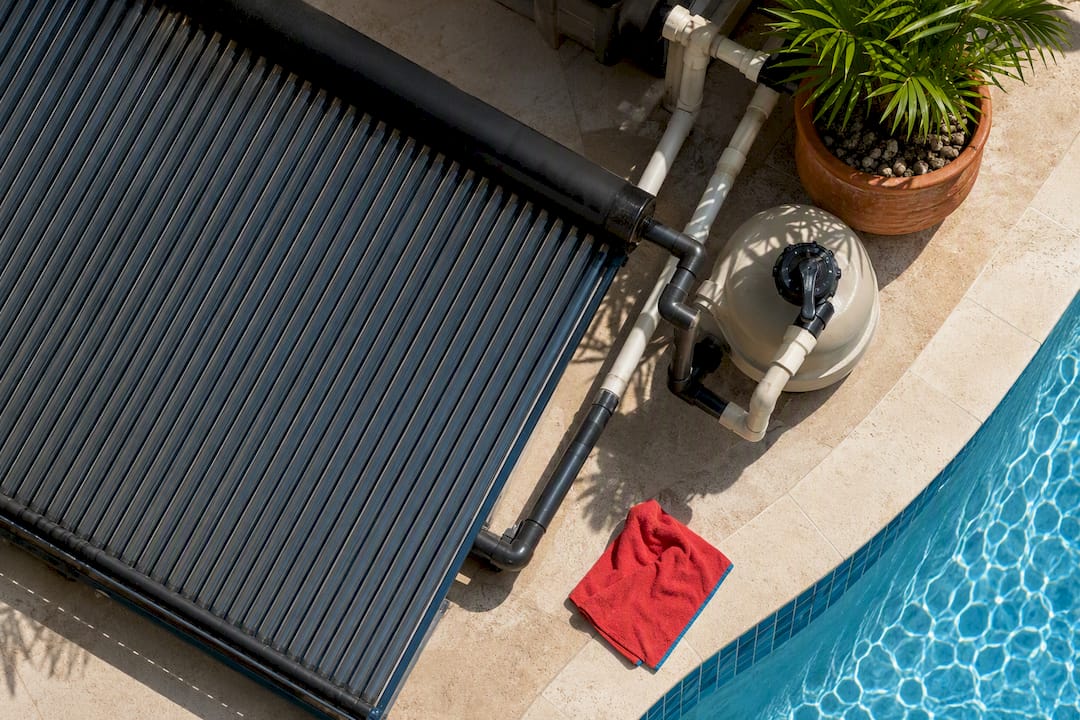
Here’s the practical logic: your home has a finite energy budget. If solar thermal collectors are covering your hot water needs directly through captured heat rather than electric resistance or heat pump water heating, that frees up more of your PV array’s output for the AC compressor instead of splitting it across multiple electric loads. In commercial settings, like a restaurant or hotel property, this separation matters even more, since hot water demand can be substantial and constant.
Solar thermal systems also tend to be simpler and cheaper per unit of energy delivered than generating that same heat electrically and running it through a PV system. That’s part of why pairing a thermal collector for water heating with a photovoltaic air conditioning setup often makes more financial sense than trying to make one PV system do everything. It’s not a flashy pairing, but for properties already managing pool heating or high hot water demand, keeping the two systems separate and specialized tends to produce lower total energy costs than consolidating everything onto solar electric alone.
Field Notes: What Real Installs Look Like
Roof orientation, shading from oak canopies, and panel counts running higher than online calculators suggest are the norm, not the exception, on real Florida properties. Installations typically run several weeks from proposal to activation. Savings ranges vary enough by home that the only number worth trusting is the one in a properly modeled, installer-quality proposal, not a generic estimate.
— Ronnie
Get an AC-Focused Solar Proposal from Florida Solar East
Get a solar system sized for your air conditioning load, not a generic panel count pulled from an online chart. Choose an installer that handles the full process end to end.

The process can include:
A site estimate that accounts for your roof, shading, and existing AC load
PV system design sized to your cooling demand, with storage options where they make financial sense
Financing options, potentially including guidance on claiming federal tax credits
Support navigating rebates and paperwork
Whether you’re cooling a single-family home or a commercial property with heavier loads, the residential and commercial solar teams build proposals around your actual usage data, not assumptions. Request your free estimate today and get a system sized for the electricity your AC actually uses.
Sources
Recommended

Comments