

$22,000–$38,000 for Florida Solar Systems, About a Decade Payback
Florida homeowners typically pay an average price per watt for a fully installed solar system, before any incentives are applied. A common 14 kW system built to cover an average Florida household can cost around the low tens of thousands of dollars upfront. Florida’s sales tax exemption and property tax exemption then cut that net cost significantly, and most homeowners see full payback within about a decade.
TL;DR:
Larger systems cost less per watt because fixed costs are spread out, with a typical 14 kW Florida system costing around $32,000 before incentives.
Florida’s sales tax exemption and property tax exemption significantly reduce net costs and help most homeowners breakeven within about a decade.
Net metering credits excess energy at the retail rate, making systems that match around 90% of your usage most effective for maximizing savings.
The system’s final price varies depending on roof condition, panel quality, inverter type, and permitting, so getting a site-specific quote is essential.
Choosing an installer with local Florida experience and proper permitting knowledge ensures better value and faster payback than simply comparing sticker prices.
Table of Contents
Solar Panels Florida Cost: Typical Price Ranges By System Size
How Incentives, Tax Exemptions, and Net Metering Cut Your Net Cost
Cash, Loan, or Lease: Which Financing Path Actually Saves You Money?
How to Estimate Your Own Solar Cost Before You Call an Installer
Why the Installer You Choose Changes Your Price and Your Payback
Solar Panels Florida Cost: Typical Price Ranges By System Size
The per-watt price you get quoted depends on system size, equipment tier, and how complex your roof is to work with. Larger systems generally cost less per watt because fixed costs like permitting and labor setup spread across more panels. EnergySage’s local Florida data estimates a statewide average price per watt, with a representative 14.7 kW system costing around $32,000 before incentives.
Here’s what that looks like at common system sizes homeowners actually buy in Florida:
5 kW system: roughly $11,000 to $15,000, sized for smaller homes or partial offset of usage
8 kW system: roughly $17,500 to $24,000, a common choice for mid-size homes with moderate air conditioning loads
10 to 15 kW system: roughly $22,000 to $38,000 (before incentives), the range that covers most single-family Florida homes with pool pumps and central AC
A turnkey quote should include the panels, inverter, racking, wiring, permitting fees, and labor for installation and interconnection with your utility. It should also include the paperwork for net metering enrollment. If a quote looks unusually low, ask what’s excluded. Cut corners on permitting or interconnection work show up later as delays or change orders, not savings.
How Incentives, Tax Exemptions, and Net Metering Cut Your Net Cost
Two Florida-specific rules do more to lower your real cost than almost anything else in the buying process, and neither one is a rebate you have to apply for.
Sales tax exemption: Florida exempts solar energy equipment from the state’s 6% sales tax, applied automatically at the point of sale. On a solar system, you do not pay the 6% state sales tax at the point of sale, saving you some money upfront.
Property tax exemption: Adding solar typically increases your home’s value, but Florida law exempts that added value from property tax assessments. You get the resale premium without a higher tax bill.
Quick math: The sales tax exemption alone saves homeowners a significant amount upfront on their system cost. Combine that with net metering credits and most systems reach breakeven within a decade.
Beyond the state-level rules:
Local and municipal rebates exist in some Florida cities but are limited, first-come-first-served, and not guaranteed year to year, according to This Old House’s incentive breakdown.
Net metering credits excess generation at the retail rate with an annual true-up; any leftover credit is paid out at an avoided-cost rate, which is lower than retail.
Investor-owned utilities are generally required to offer retail-rate net metering, but municipal and co-op utilities may have different, sometimes less favorable, terms.
The federal residential tax credit expired at the end of 2025 for homeowner-owned systems, so confirm current incentive eligibility rules with your installer before signing.
Cash, Loan, or Lease: Which Financing Path Actually Saves You Money?
How you pay for solar changes both your monthly cash flow and your eligibility for incentives. Here’s how the three main paths compare:
Cash purchase. You own the system outright from day one, qualify for every available incentive, and avoid interest entirely. This path produces the fastest payback and the highest lifetime savings.
Solar loan or HELOC. You still own the system and keep incentive eligibility, but you pay interest. Terms typically run 10 to 20 years, and comparing the loan payment against your projected electricity savings tells you whether the deal actually pencils out month to month.
Lease or power purchase agreement (PPA). A third party owns the system and sells you the power it produces. These structures play a limited role in Florida and typically disqualify homeowners from the sales tax exemption and property tax exemption, since you never own the equipment.
Before signing any loan, check the tax credit eligibility rules tied to ownership. Financing structure, not just interest rate, decides how much incentive value actually reaches your pocket.
What Net Metering Actually Does to Your Monthly Bill
Net metering is what turns solar production into real bill savings, and Florida’s version works in your favor if your utility is investor-owned. Excess kWh your system generates during the day gets credited at the retail rate, per rules established by the Florida Public Service Commission, and rolls forward month to month.
A system sized to cover roughly 90% of a $180 average monthly bill typically drops that bill to $20 to $40, mostly the utility’s fixed base charge, which solar doesn’t offset.
Municipal and co-op utilities can set different credit rates, so confirm your specific utility’s net metering rules before finalizing system size.
Florida electricity rates have trended upward for years, and every rate increase makes your locked-in solar production worth more over time.
Sizing your system to match your annual usage, rather than to maximize output, tends to produce the best return at true-up. Overproduction gets credited at avoided-cost rate, not retail, once the year resets.
What Makes One Quote Higher Than Another
Two homes with identical electric bills can get wildly different quotes, and the gap almost always comes down to a handful of site-specific factors.
Roof condition and age. If your roof needs replacement within five years, re-roofing before installation saves you the cost of removing and reinstalling panels later.
Panel tier. Standard panels cost less upfront; premium high-efficiency panels cost more per watt but produce more energy on a smaller footprint, useful for shaded or limited-space roofs.
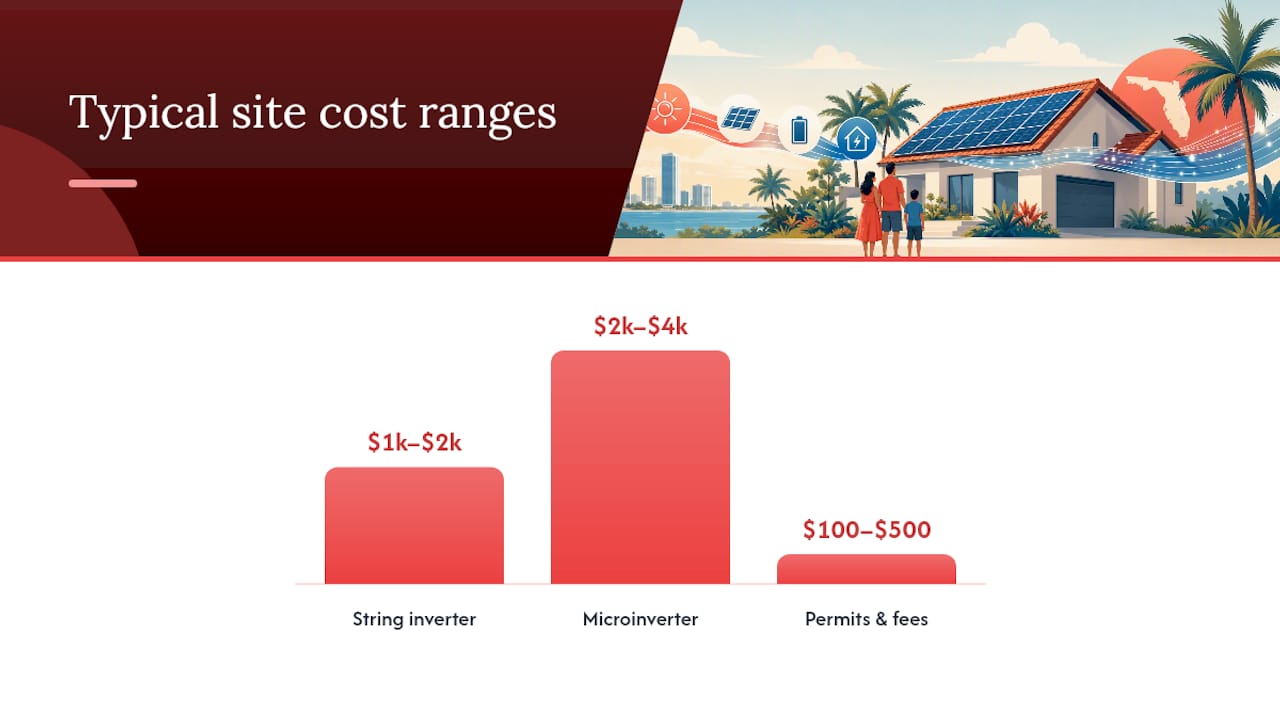
Inverter type. String inverters run $1,000 to $2,000, while microinverters run $2,000 to $4,000 but offer panel-level monitoring and better performance on partially shaded roofs.
Battery storage. Adding a battery for backup power during outages adds meaningfully to project cost and is optional for most grid-tied Florida homes.
Permitting and interconnection. County permit fees typically range from $100 to $500, and some jurisdictions require additional engineering review for older roofs.
Pro Tip: If your roof is more than 12 years old, get a roofing inspection before you get a solar quote. Reroofing after panels are installed can cost more than the reroof itself once removal and reinstallation labor are added.
For more on matching panel tier to your roof and shading situation, see how to choose solar panels for your Florida home.
How to Estimate Your Own Solar Cost Before You Call an Installer
You can build a rough, realistic estimate yourself before requesting quotes. Here’s the process:
Pull your last 12 months of electric bills and total your annual kWh usage.
Note your roof orientation, usable area, and shading. South-facing, unshaded roof space produces the most energy per panel.
Convert usage to system size using Florida’s typical production factor, supported by EIA state electricity data: divide annual kWh by roughly 1,300 to 1,400 (Florida’s average annual production per installed kW) to get your recommended kW size.
Multiply by the $/watt band ($2.18 to $3.05) to get a rough gross cost.
Subtract the 6% sales tax exemption and any local rebate you’ve confirmed is currently active.
Worked example: A 2,000 sq ft home using 14,000 kWh/year needs roughly a 10 kW system (14,000 ÷ 1,400). At $2.60/watt average, that’s $26,000 gross, minus about $1,560 in sales tax exemption, landing near $24,440 before financing or federal credit.
For a deeper walk-through, see how to size home solar for a Florida home.
Realistic Timeline and Permitting Costs to Budget For
Most Florida solar projects run six to ten weeks from site visit to activation. Permitting and utility interconnection approval, not installation itself, usually cause the longest delays.
County permit fees typically run $100 to $500, varying by jurisdiction.
Utility interconnection review can take two to four weeks after installation is complete.
Inspections generally include a building inspection and a final utility meter swap before your system is allowed to operate.
Review permit requirements early, and if your roof needs work, schedule it before your solar install date, not after.
Local Experience Behind These Numbers
These figures reflect what Florida homeowners actually see on quotes, not national averages that ignore state-specific rules. Florida Solar East has spent years pricing residential PV systems across Brevard County and beyond, and the practical advice throughout this guide, sizing to usage rather than overproduction, reroofing before installation, checking financing eligibility, comes directly from that on-the-ground quoting experience.
Before choosing any installer, take a look at Solar United Neighbors’ warnings about scams targeting homeowners, and verify licensing before signing anything.
What Solar Panels Cost You After Installation Day
The purchase price isn’t the last check you’ll write, but the ongoing costs are small compared to what you’re saving on electricity. Budget for these over a 25-year system life:
Panel cleaning: Florida’s pollen, dust, and occasional salt air buildup near the coast can reduce output slightly if panels go uncleaned. Most homeowners rinse panels once or twice a year, often doing it themselves for the cost of a garden hose.
Inverter replacement: String inverters typically last 10 to 15 years and cost $1,000 to $2,000 to replace once. Microinverters are designed to last closer to the panel’s own lifespan, reducing this cost but raising the upfront price.
Monitoring system upkeep: Most systems include app-based production monitoring at no ongoing cost, though occasional Wi-Fi router issues can interrupt data reporting.
Panel degradation: Panels lose roughly 0.5% of output per year, meaning a system still produces about 85 to 90% of its original output after 25 years.
Storm and debris damage: Florida’s hurricane exposure makes it worth confirming your homeowner’s insurance covers panel damage, since most manufacturer warranties don’t cover storm events.
Compared to the thousands you’ll save annually on utility bills, lifetime maintenance costs on a well-installed system typically stay under a few hundred dollars a year on average. For a full rundown of upkeep expectations, see solar panel maintenance for Florida homes.
Why the Installer You Choose Changes Your Price and Your Payback
The same system size can vary by thousands of dollars depending on who installs it, and the difference usually isn’t random. Installers price based on their labor costs, how they source equipment, and how much they build into the quote for warranty support and callbacks.
A lower quote sometimes reflects thinner margins on cheaper equipment, less experienced installation crews, or minimal post-install support. A higher quote sometimes reflects better warranty coverage, local permitting expertise that avoids delays, or premium panels that produce more energy over the system’s life. Neither price alone tells you which installer gives you better value.
When comparing quotes, look past the bottom-line number:
Ask how long the company has operated in your specific county, since permitting familiarity varies by jurisdiction.
Check what warranty coverage applies to labor versus equipment, since these are often separate.
Confirm the crew doing the installation is the company’s own team, not a subcontracted crew you’ve never vetted.
Compare what’s included in “turnkey” pricing, since some quotes exclude permitting or interconnection fees that show up later as add-ons.
Local installers with Florida-specific experience tend to price more accurately upfront because they already know your county’s permitting quirks and your utility’s interconnection timeline. Learn more about what to expect from solar panel warranties in Florida before comparing your final quotes.
What Actually Determines Whether Solar Pays Off in Florida
The conventional advice tells homeowners to chase the lowest price per watt. That’s backward. The number that actually predicts your payback is how closely your system size matches your annual usage, paired with how well your installer handles the permitting and interconnection steps that determine when your system actually starts producing.
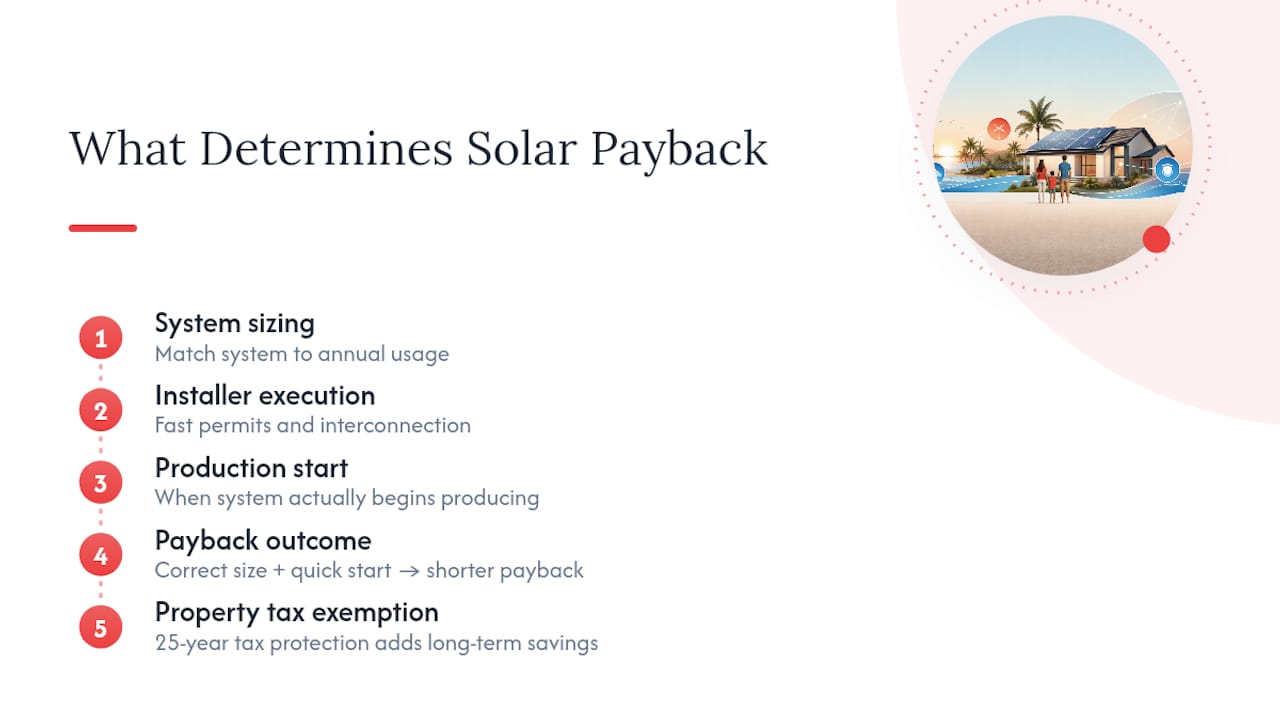
Most guides underweight the property tax exemption because it’s invisible on a quote. It’s not a rebate you see once. It’s protection from a rising tax bill for as long as you own the system, and over 25 years that adds up to real money most homeowners never calculate.
If you’re comparing quotes, prioritize sizing accuracy and installer track record over the lowest sticker price. A slightly more expensive system sized correctly to your usage, installed by a crew that gets your permits approved on the first try, will outperform a cheaper system that overproduces or sits waiting on a rejected inspection.
— Ronnie
Get a Free, Florida-Specific Solar Estimate
Every number in this guide is a starting point, not your actual quote. Your roof, your usage, and your utility’s specific net metering terms all shift the math, and Florida Solar East builds every estimate around your home’s real numbers instead of a statewide average.

A free site estimate may include a review of your roof condition, your annual usage, and available financing options, including federal tax credit guidance, so you know your net cost before committing to anything. Beyond residential PV, the company also installs solar pool heating systems, a natural add-on for Florida homeowners already looking at solar for their roof. Locally done estimates help avoid the guesswork that comes with generic online calculators that don’t consider your utility’s interconnection rules.
Ready to see your real numbers? Request your free solar estimate and get a personalized cost breakdown for your Florida home.
Sources
Recommended

Comments